Italian piadina in Poland: from recipe to profitable sales
Piadina (piada) is a thin, unleavened wheat flatbread from Romagna. In a restaurant, a food truck or institutional catering it works as a flatbread with a filling: served hot, fast to hand over and easy to fit into any menu. We help producers, restaurants and food truck operators introduce it professionally, from recipe and HACCP to costing and team training.
What is piadina
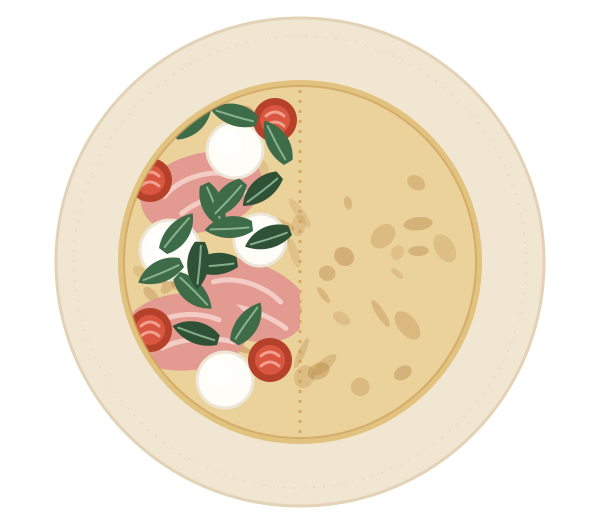
Piadina (in Italian also piada) is a thin, unleavened wheat flatbread from Emilia-Romagna in northern Italy. It is made from wheat flour, water, salt and fat, traditionally lard and today often olive oil, and baked on a hot griddle. After baking it is filled with cured meats, cheeses and vegetables, then folded in half or rolled.
It is closest to the Polish podpłomyk and the Mexican tortilla, but it differs in recipe and serving style: the fat in the dough makes it soft, and the browned spots from the griddle give it a characteristic aroma. Piadina is served hot, usually savoury (Parma ham, salami, porchetta, squacquerone or mozzarella, rocket), but it works just as well sweet, for example with chocolate spread or jam.
Piadina Romagnola is protected in the European Union as a PGI (IGP), and piadina itself has become a symbol of street food in Italy. For restaurants and producers it is a product with simple technology and great flexibility: the same base serves a meat, a vegetarian and a sweet version. The full definition, history and technology are covered on the Piadina page.
- OriginRomagna, northern Italy. The name “Piadina Romagnola” is protected as a PGI (IGP).
- Basic compositionWheat flour, water, salt and fat. No yeast starter.
- ServingHot, folded or rolled, savoury or sweet.
Where we can help
Each area has its own page with an in-depth description, a checklist and the questions customers ask most often.
Piadina
Definition, history, PGI, ingredients and technology. The core knowledge pillar on piadina for business.
Go to pageProduction
Recipe, baking lines, shelf life, packaging, HACCP and labelling for piadina producers.
Go to pageFood truck and catering
Menu, equipment, logistics and sanitary requirements for piadina on wheels and at events.
Go to pageFranchise
How to assess a franchise model in food service and what to check before signing the agreement.
Go to pageTraining
Hands-on work with dough, griddle and fillings, plus food safety basics for the team.
Go to pageKnowledge base
Guides on ingredients, equipment, allergens, food cost and legal requirements.
Go to pageWho we work with
Our offer is aimed at businesses. We adjust the scope to the scale of your operation and to your stage: from the first idea to optimising a product that already works.
- Food producers who want to start or standardise production of fresh, chilled or frozen piadina.
- Restaurants, bars and cafés (HoReCa) adding piadina to the menu as a fast, profitable product.
- Food truck and street food operators for whom short serving time and repeatable quality matter.
- Catering and institutional food service looking for a flexible dish that is easy to adapt to different groups of recipients.
- Investors considering a food service franchise who want to assess the model before deciding.
How cooperation works, step by step
A simple scheme that scales from a single venue to a production plant.
- Brief and goalsWe establish what you need: production, a new menu item, a food truck or an assessment of a franchise model, and what constraints you have (budget, equipment, location).
- Concept and costingWe choose the recipe, fillings and serving style, then calculate portion cost, margin and break-even point.
- Food safety and documentationWe prepare GHP/GMP and HACCP rules, an allergen list and label templates matched to your type of business.
- Pilot and team trainingWe test the product in practice and train the people who will make and sell it, so that quality is repeatable.
- Launch and optimisationWe start sales or production, measure results and adjust the menu, usage norms and process.
Piadina Romagnola PGI: what the specification means
What PGI protection is, what the specification covers and how to name a product that does not benefit from it.
Read articlePiadina on the menu: food cost and margin
How to calculate portion cost, choose fillings and set a price so that the product is profitable.
Read articlePiadina food truck: requirements and logistics
Equipment, registration, sanitary requirements and work organisation at events.
Read articleMichał Cierpiałowski
Food technologist (M.Sc., Università degli Studi di Udine) and consultant and lead auditor of food safety and certification systems. He speaks fluent Italian, so he works directly with Italian sources, specifications and production practices. The content of this site is prepared from the perspective of the legal, hygiene and economic requirements of Polish food service.
See the author's expertiseFrequently asked questions about piadina
Short answers. Details are on the topic pages and in the knowledge base.
What is piadina?
Piadina (piada) is a thin, unleavened wheat flatbread from Emilia-Romagna, baked on a hot griddle from wheat flour, water, salt and fat. It is served warm with a savoury or sweet filling, usually folded in half.
Is piadina made with yeast?
Traditionally it is not. It is an unleavened flatbread, and the slight lift usually comes from a small addition of baking powder or bicarbonate of soda. For this reason the dough does not need long proofing, and the flatbread bakes in a few minutes.
How does piadina differ from tortilla, lavash and pizza?
Piadina is usually thicker and softer than a tortilla, because it contains fat (lard or olive oil) and is baked on a griddle until lightly browned. Unlike pizza it is not topped before baking, and lavash is usually made without added fat. A detailed comparison is in the knowledge base.
Is the name “Piadina Romagnola” protected?
Yes. Piadina Romagnola (Piada Romagnola) is protected in the European Union as a Protected Geographical Indication (PGI, in Italian IGP). Products that do not meet the specification should not use the full protected name, and we discuss the naming rules in the article on the PGI.
What sanitary requirements apply to making and selling piadina in Poland?
The business is subject to registration or approval by the competent authority (the State Sanitary Inspection or the Veterinary Inspection, depending on the type of products) and requires GHP, GMP and HACCP principles. The scope depends on the type of business, for example a restaurant, a food truck or a production plant.
Is piadina suitable for a food truck and catering?
Yes. The dough is prepared in advance and baking on the griddle is short, so service is fast and fillings are easy to adapt to meat, vegetarian and sweet versions. Suitable equipment, cold-chain logistics and an allergen procedure are the key points.
How much does it cost to introduce piadina to the offer?
It depends on scale: a menu item in a restaurant has a different scope than a production line or a food truck. After a short brief we present the scope of work and a quotation.
Let us talk about piadina in your business
Briefly describe your situation: production, a restaurant, a food truck or a franchise. We will come back with a proposal for next steps.